
Dual Studies (Duales Studium) in Germany 2027: Eligibility, Salary & Visa Guide
This guide details the eligibility requirements, application process, typical salaries, and visa pathway for Indian, Nepalese, and Bhutanese applicants pursuing a Dual Studies (Duales Studium) degree in Germany.
This guide is currently available in English.
- Written by
- Written by Indus Emissary Editorial Team, Editorial team
- Reviewed by
- Reviewed by Indus Emissary Immigration & Admissions Consultant
- Published:
- Last substantive update:
- Last verified:
- 8 min read
Quick answer
Dual Studies (Duales Studium) in Germany combines academic learning at a university with paid practical training at a partner company. Eligibility requires a German university entrance qualification (Abitur-equivalent) and typically a C1 German level. Monthly salaries range from €1,000 to €1,600, often covering the €1,048/month living cost threshold.
Guide at a glance
| Detail | What to know |
|---|---|
| Destination | Germany |
| Route | Study |
| For | international students |
| Reading time | 8 minutes |
Quick Summary: A Dual Studies (Duales Studium) program in Germany integrates paid work experience with a bachelor's degree, offering monthly salaries of €1,000-€1,600. Applicants from India, Nepal, and Bhutan typically need a strong 12th standard result, C1 German proficiency, and both a university admission letter and a training contract before applying for a visa. The total process can take 9-15 months from the start of language learning.
Guide at a Glance: Duales Studium in Germany (2027)
| Detail | What to know |
|---|---|
| Destination | Germany |
| Primary Route | Dual Studies Bachelor's Degree (Duales Studium) |
| Basic Eligibility | University Entrance Qualification (HZB), C1 German, Training Contract with a German company, University Admission Letter |
| Language Level | C1 German (Goethe-Zertifikat C1, telc C1 Hochschule). B2 may be considered for select IT programs but C1 is the standard. |
| 2027 Salary | €1,000 – €1,600 gross per month (varies by company and sector). |
| Visa Category | National Visa (D) for the purpose of studies, § 16b Aufenthaltsgesetz (AufenthG). |
| Estimated Processing Time | Visa: 6-12 weeks after application submission. Total process (language to arrival): 9-15 months. |
System Definition & Legal Framework
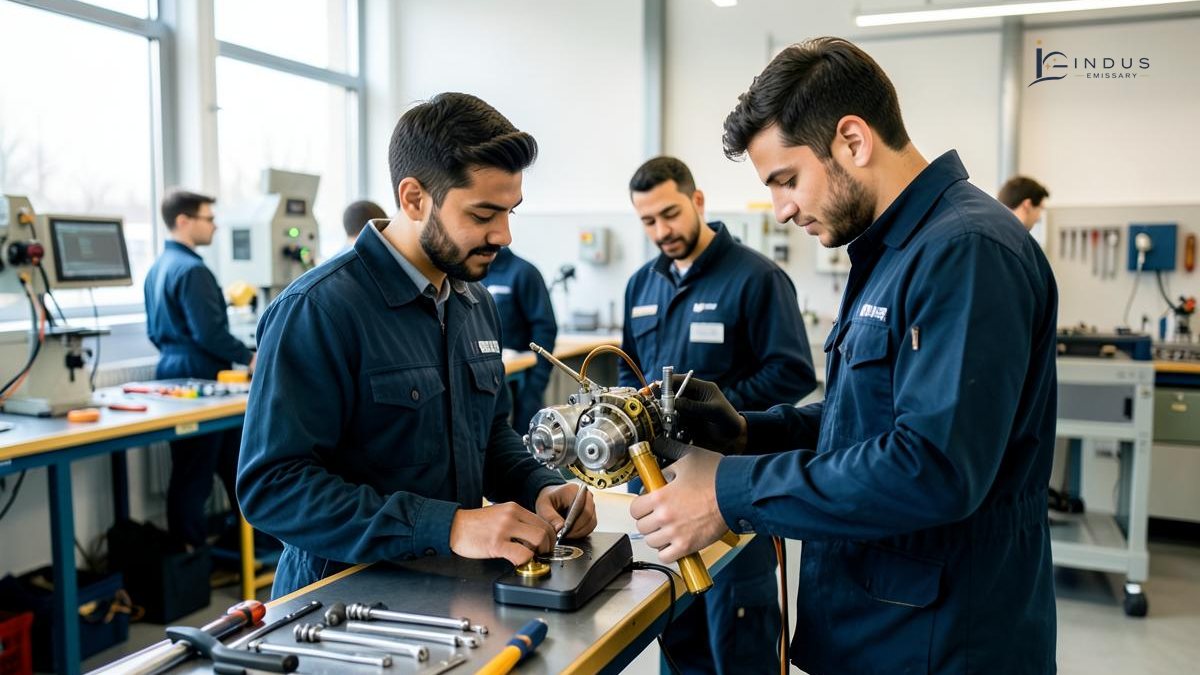
A Duales Studium (Dual Studies) is a prestigious higher education model in Germany that integrates university-level academic studies with structured, paid practical work experience in a partner company. Unlike a traditional university degree, a dual studies program is a direct path into a specific company and profession. Students alternate between phases of theoretical learning at a university or university of applied sciences (Hochschule) and practical application phases at their employer.
There are two main models:
- Practice-Integrating Model (praxisintegrierend)*: The most common model, where students complete a standard bachelor's degree program alongside extended, structured internships at the partner company. The outcome is a Bachelor's degree (e.g., B.Eng., B.Sc., B.A.).
- Training-Integrating Model (ausbildungsintegrierend)*: A more intensive model where students complete both a full vocational training qualification (like an Ausbildung) and a Bachelor's degree. The outcome is two separate qualifications: a Bachelor's degree and a vocational certificate from the Chamber of Commerce (IHK) or Chamber of Crafts (HWK).
Legally, the pathway is governed by the German Residence Act (Aufenthaltsgesetz - AufenthG). Applicants secure a National Visa for the purpose of studies under § 16b AufenthG. However, because the program involves substantial employment, the application requires approval from the Federal Employment Agency (Bundesagentur für Arbeit - BA). This Zustimmung der BA confirms that the employment conditions meet German standards.
Stream & Profile Eligibility Breakdown (India, Nepal, Bhutan)
Securing a Dual Studies position is highly competitive. Applicants from South Asia must meet both the academic criteria of the university and the professional standards of the partner company.
- * Academic Requirement (University Entrance Qualification - HZB):
- Indian Applicants: A strong senior school certificate (e.g., CBSE, ISC with 70%+ aggregate) may not be sufficient for direct entry. Many applicants will need either:
- One year of completed university education in India.
- Successful completion of the Feststellungsprüfung (FSP) exam after a one-year Studienkolleg (preparatory course).
- Exception for STEM: Applicants who have cleared the JEE Advanced exam may qualify for direct entry into technology and engineering-related dual studies programs. Your school leaving certificate and university qualifications must be checked against the Anabin database to confirm your HZB status.
- Nepalese & Bhutanese Applicants: A 12th-grade certificate is generally not considered equivalent to the German Abitur. Applicants from Nepal and Bhutan will almost always be required to complete a Studienkolleg and pass the FSP exam to gain their university entrance qualification.
- Language Proficiency:
- German: A C1 level German language certificate is the standard and non-negotiable requirement for over 95% of Dual Studies programs. Accepted certificates include Goethe-Zertifikat C1 or telc Deutsch C1 Hochschule. Companies expect you to function professionally from day one.
- English: A handful of programs, primarily in IT and international business, may be offered in English. However, these are extremely rare and even more competitive. B2 German is still highly recommended for daily life and workplace integration.
- Company Contract & University Admission:
This is a dual-application process. You must apply separately to companies and universities. Most commonly, you first secure a training contract with a company, which then supports your admission to their partner university. You need BOTH the signed contract and the letter of admission (Zulassungsbescheid) before applying for the visa.
Practical Comparison: Duales Studium vs. Classic University vs. Ausbildung
Choosing the right path depends on your academic profile, career goals, and financial situation. Use our Germany Route Finder to evaluate your specific profile against these options.
| Feature | Duales Studium (Dual Studies) | Classic University Bachelor's | Ausbildung (Vocational Training) |
|---|---|---|---|
| Primary Outcome | Bachelor's Degree + Work Experience | Bachelor's Degree | Vocational Qualification (Skilled Worker) |
| Entry Requirement | University Entrance Qualification (HZB), Company Contract | University Entrance Qualification (HZB) | School Leaving Certificate (10th or 12th), Contract |
| German Language | C1 Level (Mandatory for most) | C1 for German Taught, None for English Taught | B1 Minimum, B2 Realistic |
| Financials | Paid Salary: €1,000-€1,600/month. No Blocked Account if salary > €1,048/mo. | No Salary: Blocked Account of €12,576 mandatory. Part-time work allowed (140 days/year). | Paid Stipend: €724-€1,450/month. Blocked Account needed if stipend < €1,048/mo. |
| Work Component | Fully integrated practical phases (approx. 50% of time) | Optional internships during semester breaks | Primary focus is on-the-job training (approx. 70% of time) |
| Career Prospects | Direct employment by the partner company is highly likely. | High flexibility, but requires independent job search after graduation. | Direct employment in a skilled trade. Path to permanent residency. |
The 6-Stage Roadmap to Germany
- Phase 1: German Language Acquisition & Academic Preparation (A1 to C1)
This is the longest and most critical phase. Plan for 9-12 months of intensive study to achieve a C1 certificate from Goethe-Institut or telc. Simultaneously, research your academic eligibility (HZB) via the Anabin database and determine if you need to plan for a Studienkolleg.
- Phase 2: University & Company Application Strategy
Begin your search 12-15 months before your intended start date (typically October). Use portals like Hochschulkompass and Wegweiser-duales-studium.de to find programs. Identify partner companies and prepare a German-style CV (Lebenslauf) and cover letter (Anschreiben) for each application. Apply to multiple companies.
- Phase 3: Securing Contracts & Admission Letters
After applying, you will undergo a rigorous selection process with the companies, which may include online tests, video interviews, and assessment centers. If successful, you will receive a training contract. You will use this contract to formally apply for and receive your admission letter (Zulassungsbescheid) from the partner university.
- Phase 4: Federal Employment Agency (BA) Pre-Approval
Your employer will typically handle this step. They submit your training contract and details to the local Bundesagentur für Arbeit to obtain the necessary pre-approval (Zustimmung) for your employment as part of your studies. This document is mandatory for the visa application.
- Phase 5: National Visa Application (Consular Services Portal & VFS/Embassy)
Once you have all documents, book your appointment through the German Missions in India portal and submit your application at the designated VFS Global center. Key documents include your passport, application form, signed training contract, university admission letter, BA approval, proof of C1 German, a cover letter explaining your motivation, and proof of health insurance.
- Phase 6: Arrival, Anmeldung & Residence Permit Registration
Upon arrival in Germany, you must register your address (Anmeldung) at the local citizens' office (Bürgeramt) within 14 days. Following this, you will book an appointment at the local Foreigners' Office (Ausländerbehörde) to convert your National Visa into a residence permit for the duration of your studies.
2027 Financial & Consular Cost Breakdown
One of the main advantages of a Duales Studium is the financial independence it offers. For comprehensive support with your financial planning and document preparation, consider our advisory services for Germany.
- Monthly Salary (Vergütung)*: Your primary income. As of 2027, this typically ranges from €1,000 to €1,600 gross per month. The salary often increases slightly each year of study.
- Blocked Account (Sperrkonto)*: Generally not required. The legal requirement is to prove you have sufficient funds to cover your living costs, set at a threshold of €1,048 gross per month (as of 2027). If your monthly salary from the company is equal to or greater than this amount, the salary itself serves as proof of financial means. If your salary is lower (e.g., €950), you must open a blocked account to cover the monthly deficit (€98 x 12 = €1,176 for the first year).
- Health Insurance: Mandatory. As a student employee, you will be enrolled in the public health insurance system. Expect deductions of approximately €120-€130 per month directly from your salary.
- Consular & Application Fees:
- Visa Application Fee: €75.
- VFS Global Service Fee: Approx. €30.
- Document Notarization & Translation: €100 - €300, depending on the number of documents.
- Travel Costs:
- One-way flight from India/Nepal/Bhutan to Germany: €600 - €900.
Common Pitfalls & Agent Scam Warnings
The high demand for Dual Studies programs has attracted fraudulent agents. Protect yourself by being aware of these common issues:
- Deceptive Contract Assurances: No agent can promise you a Duales Studium corporate contract. Employer selections are made strictly by German enterprise HR committees based on academic aptitude, technical interviews, and C1 language proficiency. Any claim of pre-negotiated placement or infallible hiring is fraudulent.
- Confusing Dual Studies with Ausbildung: Some agents misrepresent Ausbildung (vocational training) as Duales Studium (a university degree). A dual studies program leads to a Bachelor's degree and requires a university entrance qualification. Ausbildung leads to a skilled worker certificate and has lower entry requirements. Clarify the exact qualification you will receive.
- Application Outsourcing: You MUST be involved in the application process. Companies will want to interview you directly. An agent who claims they will handle everything without your involvement is a major red flag.
- The only official source for visa rules are the German government portals like Make it in Germany and the websites of the German Missions in your country.
Need Guidance? Contact Indus Emissary Advisory
If you are planning your path to Germany and need personalized evaluation with language training, trade selection, document translation, or visa application filing, the Indus Emissary team is available to assist you:
- WhatsApp Advisory: Message our team directly on WhatsApp at +49 1590 5663495 for fast responses within one working day.
- Direct Email: Send your profile, marksheet scans, or questions to [hello@indusemissary.com](mailto:hello@indusemissary.com).
- Online Assessment Form: Complete our structured profile review on the Indus Emissary Contact Page.
- Interactive Tool: Run your profile through our free Germany Route Finder to identify eligible programmes.
Advisory Disclaimer: Indus Emissary provides professional advisory, profile assessment, and document preparation support. Official visa approvals and training contracts are determined exclusively by the German diplomatic missions and authorized training employers.
Frequently asked questions
- Is a blocked account required for Dual Studies in Germany?
- Generally, no. A blocked account is only required if your monthly salary is less than the official living cost threshold (€1,048/month as of 2027). If your salary exceeds this amount, the work contract itself serves as your proof of financial resources for the visa application.
- What is the minimum salary for a Duales Studium in 2027?
- There is no official minimum salary, but companies typically pay between €1,000 and €1,600 gross per month. The salary must be considered sufficient to cover your living costs, as assessed by the Federal Employment Agency and the German embassy.
- Can I do Dual Studies in Germany in English?
- It is extremely rare. Over 95% of Duales Studium programs are taught exclusively in German and require a C1 level of proficiency. A few programs in IT or International Business may exist in English, but they are highly competitive and you will still need German for daily life.
- Is there an age limit for Duales Studium in Germany?
- There is no official legal age limit. However, companies generally prefer recent school leavers and young professionals, typically between the ages of 18 and 28. Applicants over 30 may face more scrutiny regarding their motivation for starting a bachelor's program.
- Which companies offer Dual Studies in Germany?
- Many large German and multinational companies offer dual studies programs, especially in engineering, IT, and business. Prominent examples include Siemens, Bosch, Deutsche Bahn, Airbus, SAP, Daimler Truck, and numerous banks and retail chains. You can find listings on company career pages and specialized portals.
- What is the difference between Ausbildung and Duales Studium?
- Duales Studium is a university degree program (Bachelor's) combined with practical work, requiring a university entrance qualification. Ausbildung is a vocational training program that leads to a skilled worker certificate and typically requires a 10th or 12th-grade school leaving certificate.
- Is IELTS required for a Duales Studium visa?
- No. IELTS is an English language test and is irrelevant for the vast majority of German-taught Duales Studium programs. You must provide proof of German proficiency, typically a Goethe-Zertifikat C1 or telc C1 Hochschule certificate.
- How difficult is it to get a Dual Studies contract?
- It is highly competitive. You are competing with German and EU applicants. Success depends on strong academic records, proven C1 level German skills, a convincing application, and excellent performance in company interviews and assessment centers.
- What visa is needed for a Duales Studium in Germany?
- You must apply for a National Visa (Type D) for the purpose of 'Studies' under § 16b of the German Residence Act (Aufenthaltsgesetz). The application must include both your university admission and your work contract.
- Do I need to pass the JEE for Dual Studies in Germany?
- For engineering or technology-related programs, having passed the JEE Advanced can grant you direct university entrance qualification (HZB) in Germany. Without it, you may need to complete a one-year preparatory course (Studienkolleg) first.
Sources checked
- Make it in Germany - Dual studiesOfficial government
Supports: General definition of dual studies, typical salary ranges, and requirement of a contract.
- German Missions in India - National visa for studiesOfficial government
Supports: Requirements for a student visa, including the application fee of €75 and the need for proof of financial resources.
- Gesetze im Internet - § 16b AufenthG - Residence for the purpose of studyingOfficial government
Supports: The legal basis for the student residence permit in Germany.
- Anabin Database - KultusministerkonferenzOfficial government
Supports: Official portal for checking the equivalence of foreign school-leaving certificates for German university admission (HZB).
- Hochschulkompass - Study in GermanyRegulatory body
Supports: Official search engine for accredited study programmes and universities in Germany, including dual study programmes.
- Federal Employment Agency (Bundesagentur für Arbeit)Official government
Supports: Federal Employment Agency approval rules and labour market regulations
Related guides
- MS in Computer Science & AI in Germany 2027: Public Universities & Blue Card PathThis comprehensive guide outlines the 2027 requirements, public university options, curriculum alignment, and Blue Card prospects for Master's in Computer Science and AI in Germany.
- Study Master's in Germany in English 2027: Eligibility, ECTS Credits, Public Universities, APS & Visa GuideComplete 2027 guide to English-taught Master's in Germany. Understand public university eligibility, APS verification, ECTS requirements, and student visas.
- Study Bachelor's in Germany from India: 2027 GuideThis guide details the complete 2027 process for Indian students to pursue a Bachelor's degree in Germany, covering direct entry vs. Studienkolleg pathways, APS certification, and financial requirements.
- Scholarships in Germany for International Students: 2027 DAAD, Deutschlandstipendium & Foundation Funding GuideThis guide provides an authoritative overview of scholarships available for international students pursuing studies in Germany in 2027, detailing eligibility, application processes, and financial support from key organizations.
- Pursuing a PhD in Germany: 2027 Individual vs Structured Doctorate, Funding & Visa GuideThis guide provides a comprehensive overview for international students from India, Nepal, and Bhutan on pursuing a PhD in Germany in 2027, covering individual vs. structured programs, funding options, and the step-by-step visa application process.