
Ausbildung in Germany for Foreign Candidates (2026): Requirements, Stipend & Visa
Complete 2026 guide to dual vocational training (Duale Ausbildung) in Germany for non-EU candidates. Minimum stipends (€950–€1,450/month), Section 16a AufenthG visa rules, B1/B2 German, and blocked account exemptions.
This guide is currently available in English.
- Written by
- Written by Indus Emissary Editorial Team, Editorial team
- Reviewed by
- Reviewed by Indus Emissary Immigration & Admissions Consultant
- Published:
- Last substantive update:
- Last verified:
- 12 min read
Quick answer
Ausbildung is Germany's tuition-free dual vocational training under Section 16a AufenthG and BBiG. Foreign candidates receive €950–€1,450+ gross monthly stipend, zero school fees, and complete blocked account exemptions if stipend covers living costs. Class 12 and B1/B2 German are required.
Guide at a glance
| Detail | What to know |
|---|---|
| Destination | Germany |
| Route | Germany programs |
| Reading time | 12 minutes |
Sectors that recruit internationally
Demand is uneven. These fields consistently look outside Germany:
- Nursing and geriatric care
- Hotel and restaurant management
- Electrical, mechatronics and industrial trades
- Logistics and warehouse operations
- Retail and commercial administration
What breaks Ausbildung applications
Almost always one of these four:
- Language certificate obtained too late for the intake
- Interview German that cannot sustain a technical conversation
- Documents translated by unaccredited translators
- A motivation letter that reads as generic and applies to any trade
How the dual system works
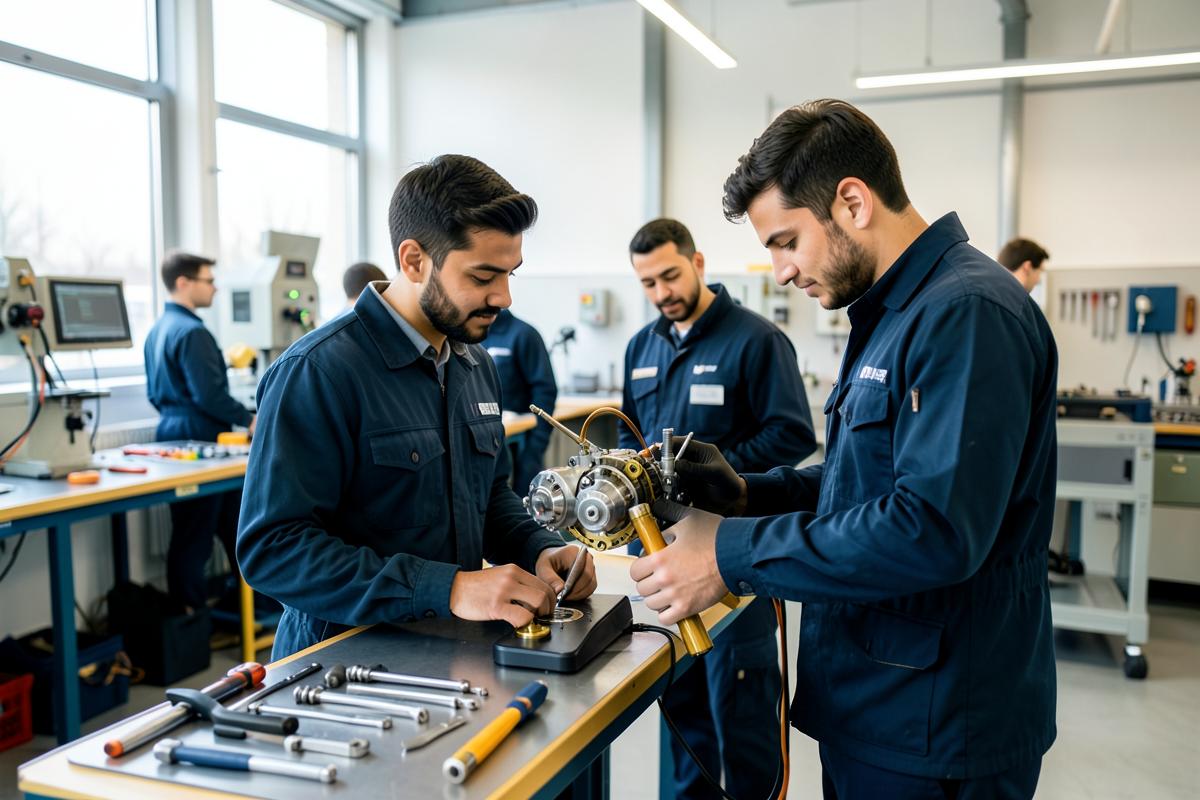
Part of each week is classroom theory at a Berufsschule; the rest is supervised work at the training company. The employer signs a training contract, pays a monthly training allowance that rises each year, and carries responsibility for your practical development.
Because an employer signs, the selection process is a real hiring process. Interviews are conducted in German, and the company is judging whether you can follow instructions on a shop floor or a ward from day one.
The honest requirements
B1 German is the practical floor and B2 is safer for care and customer-facing roles. Your school certificates must be assessed for German equivalence, and gaps in your education history need a plain explanation:
- Recognised German certificate, B1 minimum
- Certificate equivalence assessment for school qualifications
- Signed training contract with a specific company
- Proof of accommodation and, where required, a blocked account
- A CV in German format, with a motivation letter that names the trade
Frequently asked questions
- Is Ausbildung completely tuition-free for foreigners in Germany?
- Yes. Dual vocational training (Duale Ausbildung) is 100% tuition-free in Germany. State vocational schools are fully government-funded, and host training companies pay you a monthly training allowance (stipend) rather than charging tuition.
- What is the minimum monthly stipend for Ausbildung in 2026?
- Under German federal legislation, the statutory minimum training allowance in 2026 is at least €682/month in Year 1, rising to over €800 in Year 3. However, high-demand trades pay significantly higher: Nursing pays €1,250–€1,450/month, Mechatronics pays €1,050–€1,200/month, and IT pays €1,020–€1,250/month.
- Do foreign candidates need a blocked account for an Ausbildung visa?
- No, provided your training allowance covers the consular subsistence threshold (approx. €1,027 gross / €903 net per month). Because nursing, IT, and industrial engineering stipends exceed this amount, candidates in these trades do not need a €11,904 blocked account.
- Can Indian students apply for Ausbildung directly after Class 12?
- Yes. Indian students who have completed Class 12 (CBSE, ICSE, or State Boards) are fully eligible. Unlike German universities which often require a 1-year preparatory Studienkolleg, Ausbildung accepts 12th standard directly upon language qualification.
- Is there an age limit for Ausbildung in Germany?
- Legally, there is no upper age limit for vocational training under German law. While domestic German trainees are typically 18 to 22 years old, international candidates aged 25, 30, or even 35 are routinely accepted, particularly in healthcare, nursing, and technical crafts.
- What German level is strictly required to get an Ausbildung contract?
- B1 certified by Goethe-Institut, telc, or ÖSD is the baseline legal requirement. However, for nursing and healthcare roles, B2 is strongly recommended and often required by hospital employers and visa officers.
- Can I work a part-time job during my Ausbildung in Germany?
- Yes. Under Section 16a of the Residence Act, vocational trainees are legally allowed to work up to 20 hours per week in secondary employment, provided it does not interfere with vocational school attendance and employer training.
- Can I bring my spouse or children to Germany on an Ausbildung visa?
- Family reunification (Ehegattennachzug) is legally possible under Section 29/30 AufenthG, but only if the trainee can prove adequate living space and sufficient personal income to support dependents without social welfare. In practice, most trainees bring dependents after Year 1 or upon graduation.
- How long does the Ausbildung visa processing take at the German Embassy?
- Processing typically takes 6 to 12 weeks. In regions utilizing the Fast-Track Procedure for Skilled Workers (Section 81a AufenthG), an employer can pre-approve the visa with the local immigration office, accelerating consular processing to under 3 weeks.
- Can I get German permanent residence (PR) after finishing an Ausbildung?
- Yes. Under Section 18c of the German Residence Act, international graduates of a German vocational training program qualify for Permanent Settlement (Niederlassungserlaubnis) after just 2 years of skilled employment in their field.
- Which Ausbildung trades have the highest visa approval rates for foreigners?
- Healthcare and General Nursing (Pflegefachmann), Mechatronics, Electrical Technology, IT Systems Integration, and Chef/Culinary arts have the highest approval rates because they are classified as acute bottleneck professions (Engpassberufe).
- Can I switch employers if I face problems at my training company?
- Yes. Trainees can terminate a training contract during the probationary period (Probezeit, 1 to 4 months) without notice. After the probation period, changes require mutual agreement or valid cause. The switch must be reported to the Ausländerbehörde and the competent chamber (IHK/HWK).
Related guides
- BFD to Ausbildung in Germany: 2027 Residence Permit Switch, B2 German & Employer Sponsorship GuideTransitioning directly from the Federal Volunteer Service (BFD) into a paid dual Ausbildung in Germany without returning home: 2027 rules under Section 16a AufenthG, BAFzA references, stipends, and blocked account exemptions.
- Ausbildung in Germany with a Study Gap: A Comprehensive Guide for International ApplicantsThis guide provides detailed information on how international applicants with study gaps can pursue an Ausbildung in Germany, covering eligibility, requirements, and the application process.
- Germany Ausbildung After Class 12 in India 2026: Eligibility, Streams, Requirements & Visa ProcessHow Indian students can pursue vocational training (Ausbildung) in Germany directly after Class 12: stream-wise eligibility (Science, Commerce, Arts), language rules, 2026 training allowances, and the national visa application roadmap.
- How to Apply for Ausbildung from India: Complete 2026 GuideThis guide provides Indian applicants with a comprehensive roadmap for securing a German Ausbildung training contract and national visa in 2026.
- Ausbildung in Germany Over 30: 2027 Age Limits, Requirements & Career Change GuideCan you do an Ausbildung in Germany after 30? Learn about official 2027 age requirements under § 16a AufenthG, BBiG, employer selection, career change logic, stipends, and visa rules.